
Skip to content
Start Requirement ReviewStart Review

Service

Foreign Counterparty Development

Foreign counterparty development starts with a defined product, commercial purpose, proposed volume and timeline. Accord researches potentially relevant candidates and coordinates client-approved outreach and information exchange. The principals retain all commercial decisions.

Counterparty Development Pathway

  1. Requirement Definition

  2. Target Counterparty Profile

  3. Market / Jurisdiction Mapping

  4. Presentation Preparation

  5. Structured Outreach

  6. Response Coordination

  7. Principal Discussion

Role boundary. Accord does not promise introductions, responses, meetings or commercial outcomes.

Foreign counterparty development requirements

The commercial need, product, volume, payment expectation and timeline are defined before any market work begins. Foreign counterparty development needs a specific brief: the type of relationship sought, relevant markets, practical constraints and the intended first response. Mark estimates and open questions. Do not approach candidates as if proposed quantities, payment terms or commercial arrangements have already been agreed.

On this page

Target counterparty profile

Keep selection criteria, sources and dates separate from independent assessment. The International Trade Administration's evaluation guidance provides a U.S. exporter perspective on careful enquiries. A shortlist indicates potential relevance; it does not certify a party or prove commercial suitability.

Compare a candidate against the actual requirement and the quality of available sources. Keep unresolved questions and authority to share visible rather than treating an apparent commercial fit as a verified commitment.
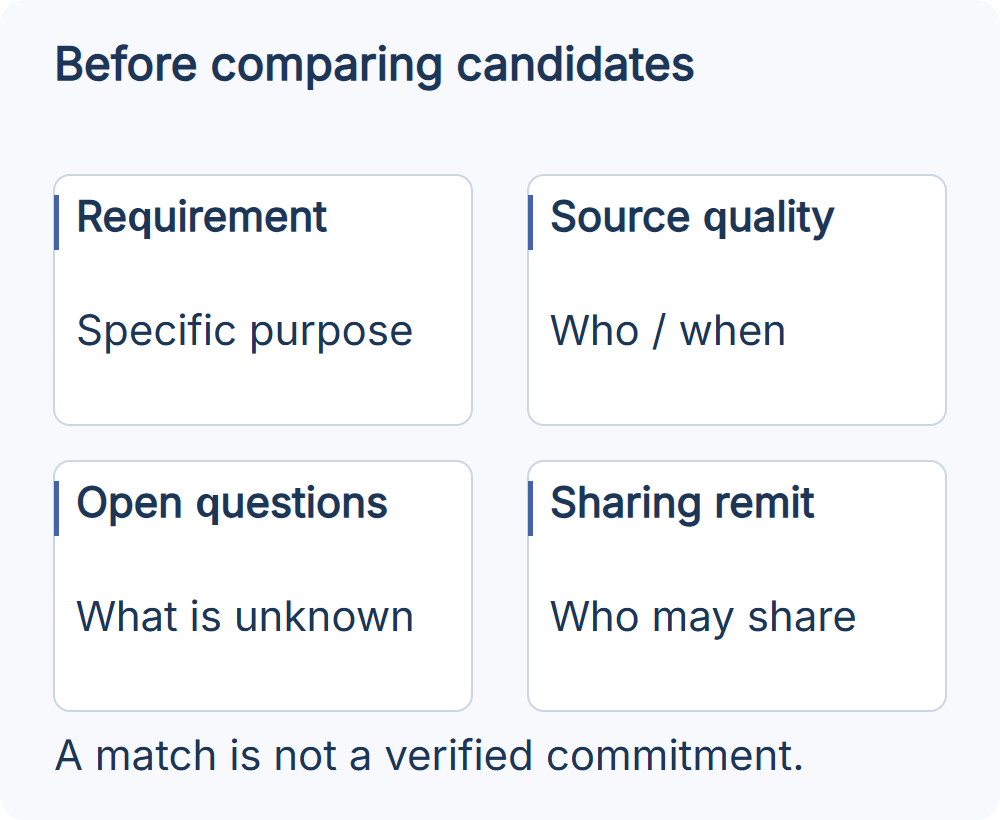
Foreign counterparty development: compare the requirement, source quality, open questions and authority to share.
Illustrative preparation map. Confirm the actual source and authority; no institutional approval, required sequence or acceptance is implied.
  • Type of organisation sought

  • Market, jurisdiction and language considerations

  • Scale, capability and experience expected

  • Instrument or payment terms contemplated

Market and jurisdiction mapping

Publicly available sources are used to build a candidate list, which the client reviews and approves before contact is made. Record the basis for each market assumption and flag product specifications or delivery constraints that still need confirmation from the client.

Market Mapping
0102030405MarketMapping

Presentation preparation

A concise, factual introduction pack is prepared: who the client is, what is sought, what is documented and what the next step would be. Use the counterparty discussion-pack guide to show the company identity, specific request, supporting records and next step. Record which version is circulated and agree permission before sharing confidential information.

Structured outreach

Approved candidates are contacted consistently, with a clear record of who was approached, when and with what material.

Response coordination and information exchange

In foreign counterparty development, an acknowledgement, request for details and commercial agreement are different stages. Route questions to the authorised source and maintain a dated response log. The development checklist helps keep preparation and responsibilities visible.

  • Logging and summarising responses

  • Coordinating clarification requests

  • Circulating agreed documents

  • Maintaining a single record of the dialogue

Illustration of a research workspace for foreign counterparty development

Direct principal discussion

Once interest exists, principals deal directly. Commercial terms, contracts and pricing are agreed between them.

Information Architecture

Discovery Funnel

  1. Research

    Market mapping

  2. Shortlist

    Approved candidates

  3. Outreach

    Structured contact

  4. Dialogue

    Principal discussion

Compliance and commercial boundaries

Counterparty due diligence, sanctions screening and contractual protection remain the responsibility of the contracting parties and their advisers.

Common gaps

Practical foreign counterparty development questions

Does appearing on a shortlist make a counterparty verified? No. Record why the candidate appears relevant, the source of that information and what remains unknown. The principals and relevant institutions undertake the reviews appropriate to their decisions. Do not describe a candidate as approved or bank verified merely because it has been identified in research.

How should replies be classified? Distinguish acknowledgement, a clarification request, willingness to discuss and an actual commercial commitment. Route questions to an authorised source and keep the scope of permitted sharing visible. An unexpected payment or sensitive-information request should follow the principal’s appropriate verification process rather than be accepted because outreach previously occurred.

Illustrative foreign counterparty development scenario. For a fictional candidate, the appropriate next action may be to obtain a product specification from the authorised technical contact. More generic presentation material would not answer that question. Use the response illustration to record the uncertainty, action owner and original reply without claiming a successful counterparty relationship.

Foreign counterparty development: distinguish research, authorised outreach and actual responses.
Illustrative preparation aid; the relevant parties and institutions retain their own responsibilities and decisions.
  • Requirement described too broadly to be actionable

  • No documentation ready when interest arises

  • Inconsistent messaging across approaches

  • No internal owner for follow-up

Key takeaway
Finding a relevant counterparty is a research and communication task — every commercial decision stays with the principals.

Keeping foreign counterparty development information current

What if the requirement changes after candidates are identified? Check whether the revised requirement changes why a candidate was shortlisted. A new specification, timing assumption or commercial objective can make an earlier introduction less relevant. Foreign counterparty development should preserve the link between the approved brief and the approach actually made. Do not continue circulating an obsolete request simply because a presentation has already been prepared.

In a hypothetical case, a company changes the product specification after initial research. Identify the revised source, the candidate criteria that need reconsideration and the authority for any further outreach. The illustration shows why receiving the new version is different from completing that reassessment. Record what remains unknown and who can answer the relevant technical question. An updated shortlist is still a research output, not certification or a commercial agreement. Principals and institutions retain their own reviews and decisions; the coordinator must not imply that a candidate has accepted requirements it has not considered.

For the working detail, use Foreign Counterparty Development Checklist.

Foreign counterparty development: a new document version is separate from a completed review.
Illustrative preparation aid; record the actual source, version and review status without inferring institutional approval.

Four checks for foreign counterparty development

A useful service enquiry identifies the commercial function sought before requesting a list of names. A potential supplier, buyer or other commercial participant may be relevant for different reasons. The four checks below help explain the task without treating identification as verification or suggesting that a candidate will agree to a transaction.

Foreign counterparty development can involve organising new research, reviewing a client-supplied list or preparing an approved first approach. Identify which activity is required and what information the principal can provide. A broad company introduction does not by itself explain the product requirement or the kind of response being sought.

Use the answers to define the next information task. Foreign counterparty development should make the principal’s objective and material constraints understandable while keeping commercial decisions with the principals. A candidate profile remains a preparation output, not certification of suitability or an agreed commercial relationship.

  • Candidate function. Identify the type of commercial participant sought and its proposed role in the requirement. Do not treat every company active in a market as a potential answer to the same request.

  • Requirement and technical source. Identify the product or activity, the material specification and the person authorised to clarify technical questions. Keep an unresolved specification visible rather than substituting a convenient description.

  • Approach authority. Identify the principal requesting the work and the scope approved for outreach. A company name or an existing contact does not establish permission to circulate confidential records.

  • Useful first response. Explain what the initial approach is intended to clarify: potential relevance, a technical question, willingness to discuss or another stated point. Do not describe that response as a commercial commitment before the principal has an actual basis to do so.

Choose the task when a client already has candidate names

A client-supplied list can be a starting point without being a completed selection. Ask why the names appear relevant and what the client wants the coordination work to add. The task might concern understanding the source information, clarifying the product requirement or preparing a factual introduction for approved contacts. It should not be assumed that the list establishes the candidates’ interest or capability.

For foreign counterparty development, distinguish a name drawn from public research from a contact who has actually responded about the current requirement. An earlier unrelated conversation can provide context, but it does not establish willingness to consider a different product or commercial proposal. Keep each entry’s basis visible.

In a fictional example, a company supplies names collected for an earlier product line while its current enquiry concerns a revised specification. The useful task is to clarify which criteria still apply and what information a principal or candidate would need to address. More generic presentation material would not settle the technical question.

Foreign counterparty development can organise the review and the proposed next approach for client approval. It cannot certify the candidates or choose the client’s commercial relationship. The principal and its appropriate advisers remain responsible for the assessment and decisions relevant to an actual transaction.

Make technical constraints answerable by the responsible source

A product name may leave important specification questions unanswered. Identify the constraint that would change why a candidate is being considered and the source who can clarify it. The coordination task is to make that question understandable, not to invent a specification or certify that a candidate can meet it.

For a hypothetical foreign counterparty development enquiry, one company team describes a broad product category while another names a particular technical requirement. Preserve both statements and identify the difference. A candidate’s general catalogue should not be presented as confirmation of the specific requirement unless the responsible source has actually addressed it.

A useful question can distinguish what is known from what needs confirmation. The principal may need to clarify its own intended use or specification before asking a candidate about possible relevance. A technical reply may then require the principal’s appropriate specialist assessment. Coordination does not replace that assessment or determine contractual acceptability.

Foreign counterparty development should preserve the capacity in which each source speaks. A commercial contact can communicate a position without becoming the authority for every technical or legal issue. Route specialist questions appropriately, and avoid translating a preliminary answer into a performance assurance or a claim that the candidate has accepted the requirement.

Distinguish a market profile from the actual candidate enquiry

Public information can help identify companies that may be relevant to a market or activity. Read the information in its actual scope. A general business profile may not explain the function the company would perform for the proposed requirement, the entity that would communicate or the current product-specific question. Record those limitations instead of extending the source’s statement.

In foreign counterparty development, a shortlist rationale should explain the connection between the source and the principal’s objective. It should not imply that an entry has been independently verified. If the role of an intermediary, supplier or other participant is unclear, identify the question rather than assigning a function from the appearance of a website or presentation.

For a fictional example, a source describes activity in a broad product category while the client is seeking a specific commercial role in a particular enquiry. The relevant preparation task is to clarify that role and the information needed for the first approach. A market label alone cannot establish a commercial relationship or willingness to participate.

Foreign counterparty development uses the profile as orientation for an approved question, not as proof of suitability. The principals decide what due diligence, professional advice and commercial evaluation they require. Accord organises information and communication within scope without certifying the candidate or guaranteeing a response.

Separate multi-product requirements before approving outreach

A client may describe several products, markets or intended uses in one enquiry. Identify which differences affect the target profile and the question proposed for each candidate. The same company may appear in more than one research context, but that does not establish that it can address every requirement or that a general response covers them all.

For foreign counterparty development, a short requirement comparison can keep the approach focused. It should show what the principal is seeking and which source can clarify a material constraint. The comparison is not a technical evaluation or a recommendation to select a candidate. It supports a more precise approved enquiry.

The prompts below can be used where several requirements would otherwise become one unclear introduction. Keep the actual product decisions and contractual terms with the principals. Foreign counterparty development should preserve useful distinctions rather than compressing different requirements into an impressive but unsupported statement of volume or capability.

  • Requirement label. Identify the particular product or activity and the principal’s stated purpose, keeping a proposed requirement distinct from completed business.

  • Material distinction. Identify the specification, intended use, commercial role or other source-supported difference that changes the candidate question.

  • Source for clarification. Identify the principal’s authorised contact who can explain that distinction; do not invent missing technical or commercial terms.

  • Candidate question. State what the first enquiry would ask about this requirement, without describing possible relevance as accepted capability.

  • Principal decision. Identify the response that needs the principal’s assessment or further advice. A coordination note does not make the resulting commercial choice.

Hand over the defined question to direct principal discussion

A useful handover identifies the requirement, the actual source information and the question a principal can now discuss directly. If the enquiry covers several products or roles, make clear which one a response concerns. Avoid presenting a general expression of interest as agreement to every part of a proposed commercial arrangement.

For foreign counterparty development, the next coordination task may be a request for clarification rather than another broad introduction. A principal can explain its own requirement; a candidate can state its own position; the parties and appropriate advisers determine how they assess the information and whether to negotiate. Coordination should keep those capacities distinct.

If direct commercial dialogue is established, clarify the actual coordination work that remains within scope. Do not create unnecessary parallel correspondence or present Accord as the party agreeing price, delivery, contractual protection or performance terms. The principals retain those decisions, including whether to continue a discussion.

Use the linked discussion-pack article for presentation guidance and the development checklist for practical preparation prompts. Foreign counterparty development remains research and communication within its actual scope. An introduction, shortlist or organised handover is not a guarantee of verification, commercial suitability, a contract or a successful transaction.

Begin with a Structured Requirement Review

Share the transaction, the parties and the documentation you already hold. Accord will organise the rest and tell you plainly what is missing.