
Skip to content
Start Requirement ReviewStart Review

COMPLIANCE

Clear Responsibilities. Transparent Institutional Boundaries.

Accord's role is coordination. Every credit, compliance and commercial decision belongs to the institutions and contracting parties involved.

Illustrative documents, laptop and notebook for a role boundary review

Role boundary. Accord coordinates preparation, documentation readiness and institutional communication. Accord is not a bank, lender, issuer, confirmer, guarantor, funder or credit decision-maker. All facilities, pricing, security, due diligence, compliance, approval, issuance, confirmation and decisions remain with the relevant institutions and contracting parties.

Accord's coordination role

Accord may help define requirements, organize information, prepare documentation-readiness packages, identify potential foreign counterparties, coordinate introductions and information exchange, and prepare parties for direct institutional review. For documentary-credit terminology, consult the ICC UCP 600 definitions where those rules apply to the credit.

Role boundary: receipt of documents is different from an institutional approval decision.
Illustrative preparation aid. Use it with the working notes; the receiving institution determines its actual requirements.

Client responsibilities

Read the responsibilities below as separate roles, not a transfer of institutional authority. The illustration identifies whose statement a question concerns; it does not replace the actual duties, checks or advice applicable to a transaction.
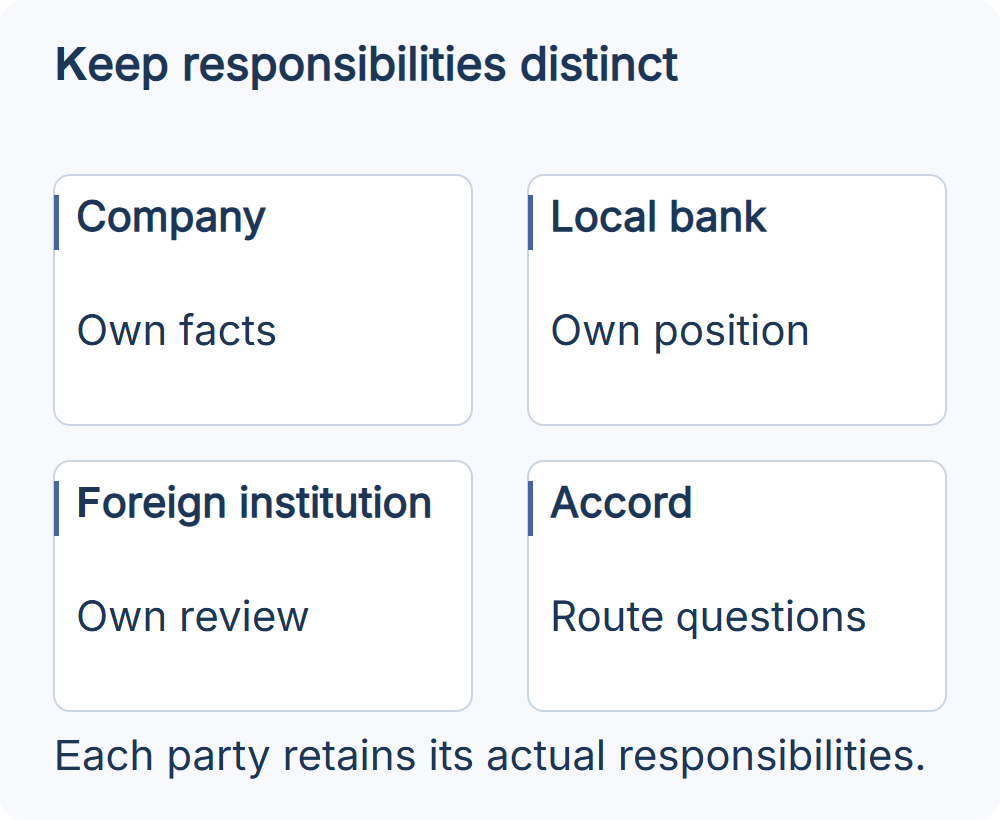
Role boundary: companies, local banks, foreign institutions and Accord retain distinct responsibilities.
Illustrative preparation map. Confirm the actual source and authority; no institutional approval, required sequence or acceptance is implied.
  • Accuracy and completeness of information provided
  • Authorising what may be shared and with whom
  • Responding directly to institutional questions
  • Obtaining independent legal, tax and financial advice
  • All commercial decisions

Institutional responsibilities

  • Due diligence and compliance screening
  • Credit assessment and limit allocation
  • Security, pricing and documentation
  • Issuance, confirmation, decline or conditions
  • All final decisions

Due diligence and compliance

Institutions apply their own know-your-customer, sanctions, anti-money-laundering and source-of-funds procedures. Accord does not perform, replace or influence those processes.

No guarantee

Nothing on this website or in any communication constitutes an assurance that a facility, instrument, confirmation, relationship or introduction will be available, accepted or completed.

No offer or commitment

Information provided by Accord is for coordination and general information only and does not constitute an offer, commitment, approval or invitation to enter into any financial transaction.

Independent professional advice

Parties should obtain their own legal, tax, regulatory and financial advice before entering into any transaction or agreement.

Information accuracy

Accord relies on information supplied by clients and counterparties, and on publicly available sources. Accord does not verify third-party information and accepts no responsibility for its accuracy.

Read the role boundary as a responsibility framework

The policy clauses above define Accord’s position. The explanations below help readers apply that role boundary to everyday coordination questions; they do not amend those clauses or add an undertaking by Accord. A clear division of responsibilities helps a reader distinguish preparation assistance from a decision about a transaction. It also helps identify the party from whom an authoritative answer is actually needed.

Begin by separating the requested outcome from the activity Accord is being asked to coordinate. Organising a discussion about a facility is different from deciding that the facility will be provided. Preparing information about a proposed instrument is different from issuing the instrument. An introduction can create an opportunity for direct communication without establishing that either party accepts the proposal.

The role boundary applies to descriptions as well as actions. A cover note, meeting summary or forwarded message should not give a coordination step a stronger meaning than it has. If a message says that information has been received, preserve that meaning. Do not describe it as an approval because approval is the outcome the sender hopes to obtain.

Where a phrase has more than one possible meaning, identify the uncertainty and ask the responsible party to clarify it. A short qualification is more useful than an impressive but ambiguous label. This approach supports transparent communication without replacing independent advice, institutional review or the contractual responsibilities of the parties involved.

Identify who can answer each institutional question

A useful responsibility map begins with the question, not with an assumed hierarchy of participants. Who can explain the company’s own facts? Who can confirm the counterparty’s stated commercial position? Which institution can communicate its own review requirements? Who is authorised to instruct circulation of the relevant material? These questions can have different answers within the same discussion.

Do not treat proximity to a transaction as authority to make every statement about it. A coordinator may know that a discussion has occurred without being able to state an institution’s final position. A commercial contact may explain a proposed term without being authorised to bind another party. Identify the capacity in which a person is communicating when that distinction affects the reader’s understanding.

Use the role boundary to route a question to its proper owner. If the question concerns a bank’s willingness to consider a requirement, the bank determines its response. If it concerns a company’s explanation of its records, the relevant company source must address it. Accord’s coordination role does not transfer those responsibilities or confer decision-making authority.

A practical note can identify the subject, the responsible source and the question still unanswered. It need not invent a formal approval chain. If authority cannot be established from the information available, keep that limitation visible and obtain appropriate clarification. Do not substitute a confident statement by a less relevant participant for an answer from the party responsible for the issue.

Attribute statements without implying independent verification

Information can be useful while its source and limitations remain important. A company summary may contain client-supplied facts; an institutional communication may describe the institution’s own question; a coordination note may organise the two. Keep these categories distinguishable. Combining them into one document does not independently verify the underlying information or resolve a contradiction between sources.

The role boundary means that a reader should not infer a verification service from orderly presentation. A prepared pack can be legible, indexed and clearly attributed while substantive questions remain open. Explain who supplied a material statement and which record it comes from. Where information has been shortened for a summary, avoid removing a qualification that changes its meaning.

The illustration distinguishes source statements from a coordination brief. It is an explanatory aid, not evidence that any real source has been authenticated. The appropriate institution or contracting party determines what review it requires. Accord does not replace that process. Source attribution helps readers decide what needs clarification without asserting that the information is accurate or acceptable.

For example, a hypothetical client note calls a requirement “agreed” while the attached institutional message requests further information. Preserve the difference rather than repeating the stronger label as a settled fact. Ask the relevant source what the label refers to. The unresolved interpretation belongs in the discussion record until it is clarified by the appropriate party.

Role boundary: distinguish the sources of company facts, bank positions and coordination updates.

Distinguish receipt, discussion and an institutional decision

Administrative progress is often useful, but it should be described precisely. A delivered message shows that a transmission step occurred. Acknowledgement shows that a recipient responded to receipt. A request for additional information shows that a question remains. None of these descriptions should silently become a statement that a facility, confirmation, instrument or transaction has been accepted.

The existing role-boundary illustration above separates receipt from approval. Apply the same distinction to meeting notes and status updates. State the observable communication and its source. If the institution has not expressed a decision, do not supply one through a progress label. The role boundary remains relevant even when several parties expect a favourable outcome or substantial preparation work has been completed.

When recording a substantive response, distinguish what it addresses from what it leaves open. An answer about the information needed for a preliminary discussion may not address pricing, availability, structure or final approval. Keep the scope of the answer attached to it. A short excerpt can become misleading if the condition or question to which it responds is omitted.

If a participant needs confirmation of the next stage, ask for clarification through the appropriate channel. Do not create a universal sequence that every institution supposedly follows. Different discussions can progress differently. Accurate status language supports coordination while preserving the receiving institution’s control over its own processes and decisions.

Keep coordination instructions separate from institutional commitments

A request to arrange a call, organise a pack or introduce a contact describes an activity. It does not itself authorise anyone to commit an institution or contracting party to the requested transaction. Define the coordination instruction in those practical terms so the person receiving it can understand the task without inferring powers that have not been established.

For instance, a hypothetical instruction to “discuss confirmation support” should be clarified into the information to assemble, the question to raise and the appropriate institutional recipient. It should not be rewritten as an instruction that a confirmation will be obtained. The latter statement would move beyond coordination and obscure the independent decision of the relevant institution.

The role boundary also matters when forwarding communications. Preserve the sender’s qualifications and distinguish the sender from the person relaying the message. A forwarding note can explain context without endorsing the message’s accuracy or extending its scope. If a response needs interpretation beyond straightforward coordination, refer the issue to the appropriate responsible party or independent adviser.

Before circulation, clarify the intended audience and the sender’s authority to share the material. These are practical preparation questions, not a new promise by Accord about confidentiality, verification or institutional acceptance. Existing privacy and legal terms continue to govern. Do not use a coordination request as permission to disclose information more widely than its authorised purpose.

Escalate uncertainty to the party responsible for resolving it

An unresolved discrepancy is a question to identify, not an invitation to invent a convenient answer. Describe the conflicting statements and their sources. Explain which part of the discussion depends on clarification. A specific question gives the responsible party a better opportunity to respond than a broad request to approve the whole pack without identifying the issue.

Apply the role boundary when selecting the recipient. A factual discrepancy in a company record needs the appropriate company source. An institutional review question belongs with the institution. A legal or regulatory interpretation may require an appropriately qualified independent adviser. Accord can help organise communication but cannot turn an unqualified participant’s opinion into an authoritative answer.

Keep the effect of an unresolved question proportionate and explicit. If it affects one assumption, identify that assumption rather than describing every aspect of the requirement as defective. If it undermines the basic explanation of the transaction, make that broader dependency visible. Do not mark a question resolved merely because the same statement has been repeated in a new format.

After clarification, identify what was answered and whether further questions remain. Avoid presenting an internal preparation decision as an institutional determination. The purpose is a clearer discussion record, not a parallel approval process. The party responsible for a decision retains that responsibility, including the ability to ask different questions or decline to proceed.

Apply the role boundary to a hypothetical preparation discussion

Consider a fictional company seeking an initial conversation about an import-related requirement. It provides a company profile, a proposed transaction summary and a message from a commercial contact. The coordinator can organise the material and identify the main unanswered question. The existence of these records does not establish the accuracy of the proposal, the contact’s authority or an institution’s willingness to participate.

Suppose the company profile and summary name different entities. A useful coordination step is to ask the company source to explain the relationship. The coordinator should not invent a group relationship, assume one entity can act for another or silently substitute the more familiar name. The response may clarify the position, but the relevant institution still decides what evidence it requires.

Now suppose a recipient acknowledges the pack and requests another document. The correct status describes that request. It does not state that the transaction is approved subject only to an administrative formality. The role boundary prevents a hopeful interpretation from replacing the actual communication. The next practical task is to route the document question to the appropriate source.

Finally, the parties may decide to discuss the requirement directly. An introduction remains an introduction. Any subsequent institutional or contractual position must come from the responsible party in its proper context. This fictional sequence illustrates communication discipline; it is not a completed transaction, a case study, a prescribed institutional process or a representation that a particular outcome is available.

Preserve the role boundary in a qualified handover

A useful handover tells the next reader what is being discussed, which records support the explanation and which material questions remain. It should be possible to understand the purpose without reading a claim of success into the fact that the pack is organised. An orderly presentation supports clarity; it does not create an institutional commitment.

Check that the cover explanation and its attachments use consistent role descriptions. If a company is proposing a transaction, say that it is proposed. If a bank has supplied a question rather than a decision, preserve that distinction. If a third-party statement has not been clarified, identify its source and limitation. The role boundary is clearest when these descriptions remain visible at the point of use.

Relate the requested next step to the party who can undertake it. An invitation to clarify facts, review information or arrange direct communication should not imply that the recipient is expected to approve a transaction. Keep timing expectations similarly qualified. A preferred commercial date is not a guarantee of institutional processing, availability or completion.

For the practical preparation prompts, use the existing readiness resources and the Compliance and Role-Boundary Guide. For contractual, legal, tax, regulatory or financial implications, obtain the appropriate independent advice. The policy clauses on this page remain controlling; these explanations help readers apply them without expanding Accord’s facilitator-only role or the responsibilities it accepts.

A useful role boundary check asks whether the proposed wording still holds if the recipient declines the requirement. If a note would become false simply because no transaction follows, it may describe an expected outcome as though it were already established. Revise it to identify the actual preparation activity or communication, while leaving the institution or contracting party free to make its own decision.

Begin with a Structured Requirement Review

Share the transaction, the parties and the documentation you already hold. Accord will organise the rest and tell you plainly what is missing.