
About
A Coordination Practice for International Trade Requirements
Accord Trade Finance organises requirements, documentation and institutional communication so trade and project discussions can proceed on clear information.
Identity & Role Architecture
Public Brand
Accord Trade Finance
Public-facing brand name used across this site and correspondence
Legal Entity
Accord Trade Solutions Limited
All engagements and contracts are conducted in this name
Coordination Role
- Facilitation
- Requirement structuring
- Documentation readiness
- Relationship development
- Institutional communication
Audience Relationships
Businesses & Project Sponsors
Banks
Foreign Institutions & Counterparties
Accord coordinates between these audiences — and is not the financial intermediary between them.
About Accord Trade Finance
Accord Trade Finance is the public brand of Accord Trade Solutions Limited. Accord facilitates international trade-finance coordination, transaction origination, documentation readiness, institutional communication and foreign counterparty development for businesses, banks, foreign institutions and project sponsors.
On this page
Brand and legal entity
All engagements are conducted by Accord Trade Solutions Limited. "Accord Trade Finance" is the public-facing brand name used across this website and in correspondence. The legal entity name appears in all contractual documentation.
Purpose
Trade finance discussions can be difficult to assess when the request, source records or responsibilities are unclear. Accord helps parties define the requirement, organise supporting information and communicate with relevant institutions. The ICC documentary-credit guide distinguishes banking functions; Accord's preparation work does not occupy issuing or confirming roles.

Coordination scope
Accord's coordination work identifies the transaction, parties, instrument or facility, documentation status and intended institutional route. The aim is a reviewable information pack, assigned questions and appropriate communication. Clients provide accurate records and make commercial decisions; institutions determine approval and terms.
At the beginning of a discussion, identify the company contact responsible for the information, the specific coordination requested and any authority needed before records are shared. A prepared pack should distinguish current documents, estimates and unresolved questions so parties can see what requires confirmation. The scope of work and the institution's own review requirements remain separate.
- 01
Defining requirements and structuring the information around them
- 02
Organising documentation and identifying gaps
- 03
Identifying potentially relevant foreign counterparties and institutions
- 04
Coordinating introductions, meetings and information exchange
- 05
Preparing parties for direct institutional review
Audiences
Accord works with importers and exporters, banks, foreign financial institutions and project sponsors. Each audience has its own page describing how coordination typically works.
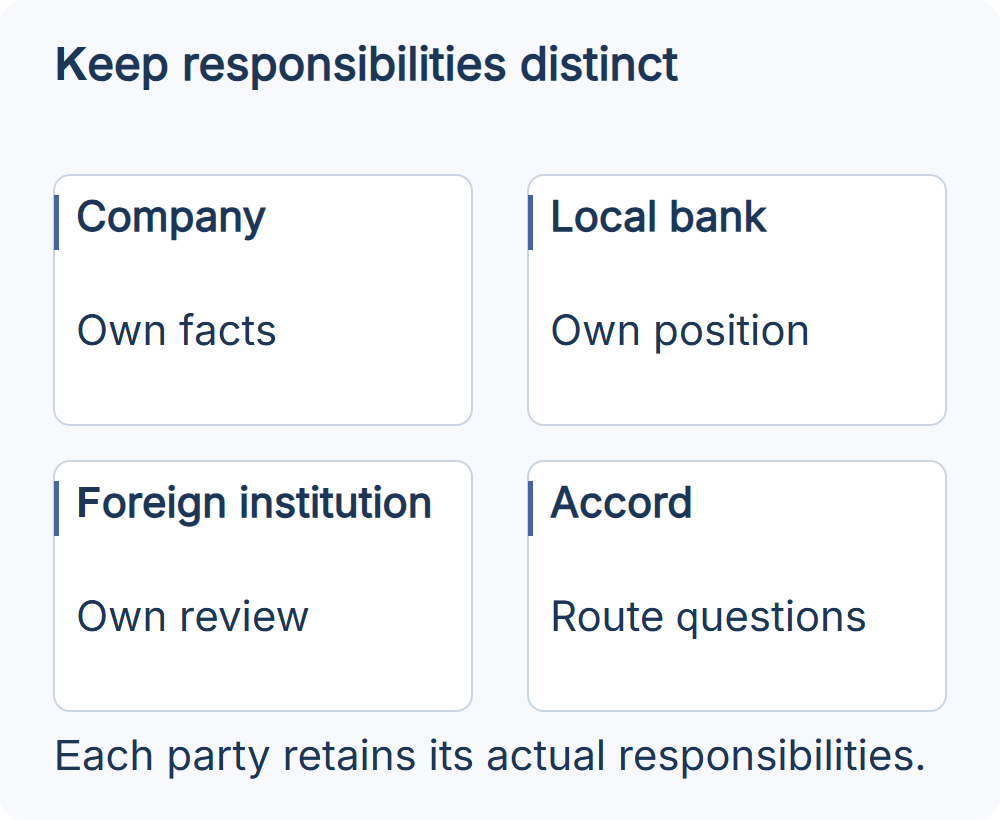
Use the map to distinguish the people in a discussion from the decisions they retain. A company speaks for its facts, a bank for its own position and an institution for its review; Accord coordinates the questions.
Principles
- 01
Clarity — requirements described in transaction terms, not outcome terms
- 02
Readiness — information prepared before institutions are approached
- 03
Responsible communication — no promises of access, approval or funding
- 04
Compliance awareness — institutional and regulatory processes respected
- 05
Institutional respect — decisions belong to the institutions that make them

Reasons to engage
Read how documentation readiness supports an initial discussion and how facilitation differs from financing. These guides explain preparation responsibilities, not promised institutional outcomes.
For a fictional example, a company has a preliminary requirement and asks whether an introduction means approval. The useful next step is to identify available evidence and the responsible decision-maker, not to imply that Accord has supplied a bank undertaking. Record the unanswered question and its source before describing progress.

- 01
A requirement that has not yet been described in reviewable form
- 02
Documentation spread across teams, versions and formats
- 03
A need to identify counterparties in unfamiliar markets
- 04
Preliminary discussions that need consistent coordination and follow-up
Role boundary
Accord coordinates preparation, documentation readiness and institutional communication. Accord is not a bank, lender, issuer, confirmer, guarantor, funder or credit decision-maker. All facilities, pricing, security, due diligence, compliance, approval, issuance, confirmation and decisions remain with the relevant institutions and contracting parties.
Practical Accord Trade Finance questions
How should an Accord progress update be read? Separate the coordination work described from any decision that belongs to an institution. Ask which source, date and qualification support the update. Receipt of a pack, a meeting invitation and an institutional commitment are different statements; the brand description must not blur those responsibilities.
What should a first enquiry establish? Identify the actual applicant or principal, the commercial requirement and the work for which coordination is sought. Clarify who may authorise sharing and who can answer questions about the underlying records. Obtain the actual engagement scope rather than assuming that a corporate introduction includes financing or specialist advice.
Checking names and roles in a discussion
How should names be checked across a discussion? Use the approved corporate distinction: Accord Trade Finance is the corporate brand of Accord Trade Solutions Limited. That description does not itself identify the contracting party in another company’s transaction. Check the actual names and roles in the relevant engagement, commercial records and institutional correspondence. Where a trading name differs from a legal name, ask the responsible source to explain the relationship instead of silently treating the names as interchangeable.
For a hypothetical client, an introduction may use a familiar brand while an invoice names its legal entity. Record what needs clarification and which source can answer it; do not invent ownership or authority from a logo. Keep the corrected explanation connected to the relevant record and tell the appropriate recipient what changed. This is an information-coordination method, not verification of ownership, a legal opinion or certification of any third party. Ask for the actual scope and authority of the party speaking before relying on a claimed commitment.
For the working detail, use Importer / Exporter Company Profile Checklist.
Decide whether coordination addresses the actual difficulty
Coordination is most useful when the difficulty can be described as a practical information or communication task. A company may know the commercial objective but be unable to present the requirement clearly. Several contributors may hold different parts of the supporting record. A proposed institutional discussion may lack an agreed question. These are different situations, and they should not be reduced to a general request for finance.
When considering Accord Trade Finance, explain what is preventing a useful next discussion. Identify whether the immediate task concerns the requirement narrative, documentation gaps, a potential counterparty profile or communication between parties. This explanation helps distinguish coordination from a need for a credit decision, legal interpretation or a commercial negotiation that belongs elsewhere.
Ask what coordination would change in the reader’s understanding. A useful answer might identify a clearer transaction summary, a record of outstanding questions or an organised institutional discussion. It should not promise the availability of a product or a favourable response. The value of Accord Trade Finance must be assessed within its actual facilitation scope, rather than by attributing financing powers to the brand.
Before agreeing to a proposed engagement, ask which coordination tasks are included, which are outside scope, who supplies the underlying information and how commercial terms are documented. Clarify fees, timing assumptions and any third-party dependency with the actual contracting party rather than inferring them from a website description. A clear explanation of the work is different from a promise about its outcome. Keep those engagement questions separate from the institution’s own terms for any transaction it may consider.
Use the five principles to frame a scoping conversation
The five principles above describe the intended discipline of coordination: clarity, readiness, responsible communication, compliance awareness and institutional respect. They are not five stages that every transaction must pass through. Use them as questions about the proposed work, keeping the actual scope and the responsibilities of the relevant parties explicit.
For clarity, ask whether the requirement can be explained without relying on an assumed outcome. For readiness, identify what information is available and which important questions remain. Responsible communication asks whether the explanation preserves its limitations. Compliance awareness means respecting the institution’s processes, not claiming that Accord Trade Finance has completed them. Institutional respect keeps decisions with the parties authorised to make them.
A scoping conversation should make these distinctions easier to understand. If the discussion instead creates uncertainty about who provides funding, who verifies information or who can commit an institution, clarify that misunderstanding before proceeding. The principles support accurate expectations. They do not add a guarantee of service results or replace the terms governing an actual engagement with Accord Trade Solutions Limited.
Make the initial coordination request specific and proportionate
A first enquiry can explain the context without sending an entire confidential business archive. Identify the actual principal, the type of requirement, the parties’ roles and the coordination question. Describe the information already available at a high level. Keep sensitive records for the appropriate authorised exchange rather than including unnecessary personal or confidential details in an introductory message.
For Accord Trade Finance, a precise request is more useful than a list of product names without a transaction explanation. State what help is being sought: organising the requirement, preparing for a discussion, defining a potential counterparty profile or clarifying communication tasks. If the scope is uncertain, say which interpretations need to be distinguished rather than presenting one as agreed.
Timing can be described as a commercial dependency without turning it into a promise about institutional action. Explain what date matters, why it matters and which assumption remains unconfirmed. Accord Trade Finance cannot guarantee that an institution will consider or complete a requirement within that period. A clear initial request makes the dependency visible while preserving realistic expectations for the next discussion.
Coordinate across teams without obscuring the responsible source
A requirement may involve company management, operational staff, professional advisers and institutional contacts. Different contributors can answer different questions. The person assembling a pack should be able to identify the source of a material statement rather than presenting every contributor’s note as the same type of evidence. Clear organisation does not independently establish that a statement is accurate.
When discussing work with Accord Trade Finance, identify who can clarify the company’s own information and who is authorised to communicate on the relevant subject. If a figure or description is disputed, preserve the question for that source. Do not resolve a contradiction by copying the more convenient wording into a new summary or by assigning authority to a contact merely because the contact responds quickly.
The practical coordination task is to keep questions understandable as they move between contributors. A short explanation of the issue, its source and its significance can reduce repeated general requests. Accord Trade Finance may help organise that exchange within scope, while each contributor remains responsible for its own statements and the institutions retain their independent review and decision-making responsibilities.
Distinguish a relationship objective from a transaction objective
A company or institution may seek a broader relationship conversation, while another enquiry concerns a specific transaction. These objectives can be related without being interchangeable. A relationship introduction does not establish a facility, and a transaction discussion does not necessarily define an ongoing institutional relationship. State which objective the proposed coordination is intended to support.
For example, a fictional business wants to understand whom to approach in an unfamiliar market but has not described a specific commercial requirement. Its immediate coordination question differs from that of a business with an identified transaction and an outstanding institutional information request. The example illustrates scope selection; it does not describe an Accord Trade Finance client or imply that an introduction will be available.
Where both objectives matter, separate them in the enquiry. Identify the relationship question and the transaction question, then explain their dependency if one exists. Accord Trade Finance should be understood as a facilitator of the relevant preparation and communication, not as the institution whose participation is sought. Use the existing service and audience pages for the distinct scope, rather than assuming that one introduction resolves every requirement.
Assess the coordination output on its stated purpose
A coordination output should be read against the task it was prepared to support. A transaction explanation can make a requirement easier to understand while leaving evidence questions unanswered. A discussion note can identify what was said without establishing acceptance. A counterparty profile can define a search objective without certifying a particular organisation. Presentation quality and institutional outcome are separate considerations.
When reviewing material prepared for an Accord Trade Finance discussion, ask whether the question is clearer, important sources remain attributable and the unresolved points are visible. Identify which party can answer the next question. Avoid treating the absence of a recorded objection as a favourable decision. A prepared record should not imply more than the underlying communications and actual responsibilities support.
If the output does not address the agreed coordination question, clarify the missing explanation within the relevant scope. If the remaining issue requires a bank decision, legal advice or a contracting party’s instruction, route it accordingly. This keeps the discussion focused on useful work while preserving the limits of Accord Trade Finance and the independence of those responsible for substantive decisions.
Keep expectations clear when a discussion changes direction
A coordination discussion can change when new information identifies a different party, requirement or dependency. Explain the change rather than carrying the original label into every later exchange. A request that began as an introduction may become a question about missing company information. A project discussion may reveal a separate transaction issue that needs its own explanation.
Before treating the new task as part of the existing work, clarify its purpose and the relevant scope. Identify what information can still be reused, what needs correction and who can authorise the next communication. Accord Trade Finance does not acquire additional institutional powers because the discussion has become more complex. The facilitator-only distinction remains applicable throughout.
Use the service pages, audience pages and readiness resources to orient the next question. These materials explain different preparation tasks rather than guaranteeing a route to approval. Where specialist advice or an institutional decision is needed, recognise that dependency explicitly. A clear understanding of Accord Trade Finance is one that connects the brand and legal entity to practical coordination work without attributing another party’s responsibilities to either.
Begin with a Structured Requirement Review
Share the transaction, the parties and the documentation you already hold. Accord will organise the rest and tell you plainly what is missing.