
Service
Foreign Bank Relationship Development
Foreign bank relationship development begins with a specific product, market and transaction objective. Accord organises institution profiling, readiness information and approved outreach, with consistent communication, without representing any institution. Onboarding, relationship acceptance and limits remain institutional decisions.
Relationship Development Pathway
- 01
Requirement / Product Fit
- 02
Institution Profile
- 03
Transaction Pipeline Presentation
- 04
Onboarding / Readiness
- 05
Preliminary Outreach
- 06
Meeting / Information Exchange
- 07
Institutional Decision Boundary
Role boundary. Accord holds no mandate from, and claims no partnership with, any institution unless separately documented between the parties themselves.
Foreign bank relationship development objectives
What the requesting party actually wants from the relationship — trade instrument capacity, market coverage, product access or transaction flow — defined before any outreach begins. Foreign bank relationship development should distinguish a corporate transaction enquiry from a bank-to-bank objective. Identify who is approaching, what institutional function is relevant and what response is sought. A broad request for a foreign banking partner is not a substitute for this explanation.
On this page
Institution and market profiling
Publicly available information on institutions active in the relevant markets and products is organised into a shortlist for the requesting party to review and approve. Record the reason an institution appears relevant, the public source and its date, and any unanswered question. The IFC trade programme illustrates separate bank roles in a specific arrangement. It does not establish current appetite, eligibility or an Accord affiliation.
Compare market fit, product interest, the pipeline source and authority to share. An answer in one area does not establish the others or imply a banking commitment.

Geographic and product-fit mapping
- 01
Corridors and currencies relevant to the flow
- 02
Instrument types the relationship would cover
- 03
Typical transaction size and frequency
- 04
Regulatory or market considerations the parties should raise directly
Transaction pipeline presentation
A relationship request is stronger when it is supported by identifiable flow. Accord helps present pipeline information accurately and without overstatement.
Onboarding readiness
Identify the responsible team, information available and material gaps. Follow the institution's instructions for confidential records and distinguish a preliminary introduction from its formal onboarding process. An acknowledgement, meeting or request for documents must not be reported as relationship acceptance or an available limit.
- 01
Corporate and constitutional documents
- 02
Ownership and control information
- 03
Compliance policies and governance summary
- 04
Financial information and audited statements
- 05
Existing correspondent arrangements
Preliminary outreach
Approved institutions are approached with a concise, factual introduction. No response, meeting or relationship is promised at any point. Identify an authorised substitute contact for absences and record the date of each introduction, so institutional questions are routed consistently.

Meeting coordination and information exchange
Accord arranges scheduling, circulates agreed materials, records action points and coordinates follow-up between the parties. Prepare the institution discussion pack and consult the foreign bank relationships guide. Keep one communication owner and record the actual stage, outstanding questions and next agreed action in foreign bank relationship development.
Information Architecture
Relationship Development
- 01
Profile
Institution & market
- 02
Pipeline
Transaction presentation
- 03
Outreach
Preliminary contact
- 04
Dialogue
Information exchange
Relationship and decision boundaries
Onboarding, account opening, limit setting and relationship acceptance are institutional decisions. Accord does not negotiate terms or act on behalf of any bank.
Practical foreign bank relationship development questions
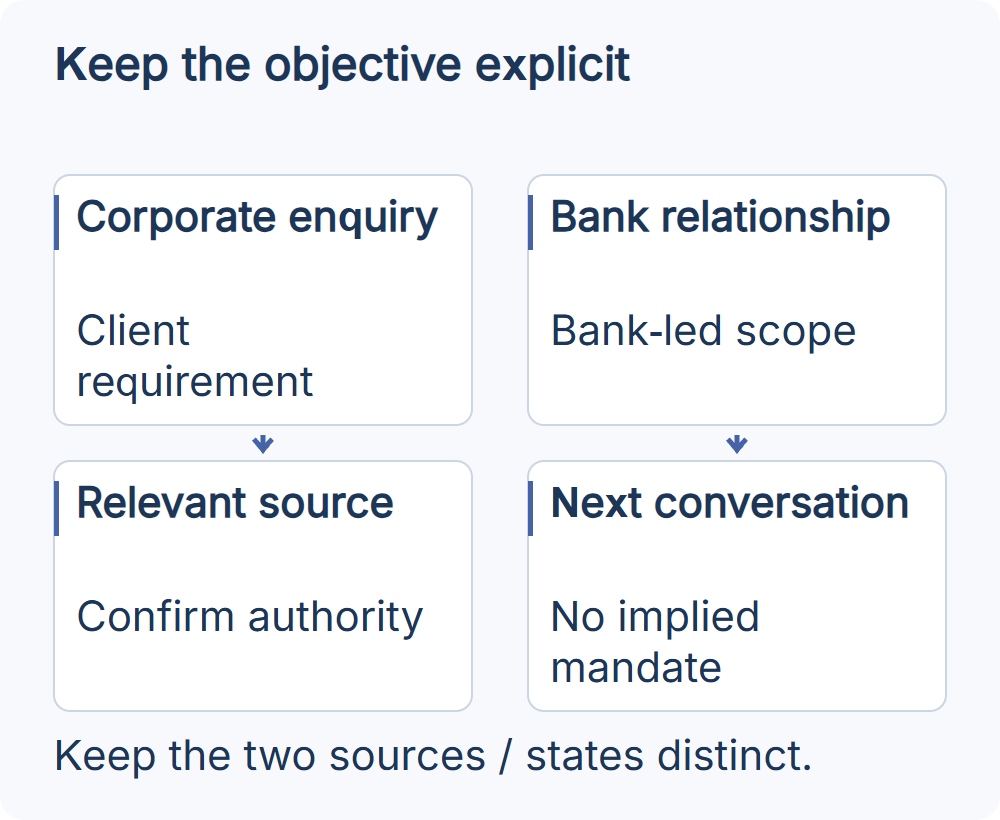
Is a corporate enquiry the same as a bank relationship mandate? No. Identify whose relationship objective is being discussed and who is authorised to represent that party. A company’s request for an introduction should not be described as an institution appointing a coordinator or agreeing a correspondent relationship. Keep the intended scope explicit before outreach.
What belongs in the next institutional conversation? Provide relevant, sourced context about the objective and actual transaction pipeline, while identifying assumptions and open questions. Use the institution’s own response to describe its position. A meeting or exchange of information is not evidence that onboarding, limits, pricing or a relationship decision has been completed.
Illustrative foreign bank relationship development scenario. In a fictional enquiry, a client wants access to a foreign bank but has not defined the proposed activity. Clarify the objective and authorised source before circulating a broad request. The two-conversation illustration helps distinguish corporate information gathering from a bank-owned relationship discussion without implying a partnership.
Correspondent relationships develop through preparation, relevance and consistent communication.
Keeping foreign bank relationship development information current
How should pipeline changes be explained to an institution? Distinguish the proposed activity from completed business and identify the reporting date and source of each statement. Foreign bank relationship development is weakened when an introduction implies a confirmed pipeline or mandate that the source has not established. Give the institution enough relevant context to understand the objective while retaining the limitations and unanswered questions in the actual information.
For a fictional example, a company updates its intended product mix after an introduction has been prepared. Identify which version of the brief and supporting records now describes the objective. Clarify the change before repeating an earlier description in another approach. The two-track illustration separates a newer file from a completed review of its implications. Record the source, the recipients who need the update and the next authorised action. An improved brief can make a conversation more relevant; it does not establish onboarding, a correspondent relationship, limits or an institutional commitment.
For the working detail, use Building Productive Foreign-Bank Relationships for Trade-Finance Requirements.

Three checks for foreign bank relationship development
A shortlist is useful only in relation to a defined approach. Before discussing particular institutions, identify the requesting party, the banking function being considered and the purpose of the next communication. The three checks below help separate those questions. They do not establish that an institution is suitable, willing to engage or able to provide the requested service.
Foreign bank relationship development can begin with an existing list of institutions or with a need to organise potentially relevant public information. In either case, the coordination task should explain why a particular institution appears relevant to the stated objective. A recognisable banking brand is not a substitute for that explanation.
Use the checks to identify what still needs clarification before approved outreach. Foreign bank relationship development does not appoint Accord to act for a bank or transfer the institution’s decisions to the requesting party. The source and limits of the information should remain visible throughout the approach.
- 01
Requesting-party objective. Identify who is seeking the discussion and what institutional function or market question is relevant. Distinguish a corporate transaction enquiry from a bank-owned relationship objective.
- 02
Source-based relevance. Identify the public or authorised source suggesting that the institution may be relevant to the stated product and market. Record what the source actually establishes and what it leaves unanswered.
- 03
Authorised next approach. Identify the purpose, approved recipient and scope of information proposed for the introduction. A shortlist entry is not authority to circulate confidential material or describe the institution as an Accord partner.
Define the work when a requesting party already has a bank list
A requesting party may supply several institution names and ask for introductions. Begin by clarifying what work remains. The need may concern organising the objective, checking the context of public information or preparing a factual introduction for an approved recipient. It should not be assumed that the coordinator can secure access or a favourable response merely because names have been supplied.
For foreign bank relationship development, identify why each name appears on the list. A source may describe a general market presence while the requesting party needs a specific function. Another name may come from an earlier unrelated discussion. Keep these reasons distinguishable rather than giving every entry the same implied status.
In a fictional enquiry, a company supplies a list assembled from several presentations but cannot explain which institutions were associated with the current proposed activity. The useful task is to clarify the selection basis and the intended question. It is not to present the entire list as confirmed institutional interest or a set of existing relationships.
Foreign bank relationship development can organise that review for the requesting party’s approval. The actual institution determines whether it will engage and what process or information it requires. No shortlist, company introduction or coordination instruction establishes acceptance, onboarding, a limit or the availability of a product.
Identify the relevant entity, market and banking function
A banking name in a public source should be read in its actual context. Identify which entity, office or market the source describes and which function is relevant to the approach. If the information does not establish that relationship, record the question. Do not assume that a group-level description answers every local or product-specific enquiry.
For a hypothetical foreign bank relationship development task, a source describes a product in one market while the requesting party is considering a different market or institutional function. The coordination task is to identify the gap between the source and the objective. It is not to extend the source’s statement to another setting without clarification.
Keep the distinction between public description and current institutional response. A public webpage may provide useful orientation, but it does not state the institution’s position on the particular proposed relationship. The relevant institution supplies its own answer. Record uncertainty plainly where the source does not support a more definite description.
Foreign bank relationship development should therefore use a qualified relevance note rather than a claim of verified suitability. The requesting party can review why a name is being considered and which question an approach would ask. That preparation does not replace institutional due diligence, professional advice or the bank’s own decisions.
Use a source-fit note instead of a promotional institution profile
A concise source-fit note can connect the requesting party’s objective to the information available about an institution. It should not read as a promotional endorsement or imply that the institution has authorised Accord to represent it. The value lies in a clear explanation of possible relevance and the limits of that explanation.
In foreign bank relationship development, a note should preserve the distinction between a public source, a requesting party’s objective and an institution’s direct communication. These inputs answer different questions. A public programme or product description does not establish that the requesting party is eligible or that a relationship decision has been made.
The prompts below are an optional preparation aid for an approved approach. They do not rank institutions, recommend a financial provider or create an institutional selection standard. Use foreign bank relationship development to organise the question accurately, while the requesting party and institution retain their actual responsibilities.
- 01
Objective being considered. State the specific function, product or market question and identify the principal requesting the discussion.
- 02
Relevant source. Identify the source and its date or context, including the entity or market it actually describes. Do not imply current coverage beyond that context.
- 03
Reason for possible relevance. Explain the limited connection between the source information and the stated objective, separating that reasoning from confirmed institutional interest.
- 04
Unanswered institutional question. State what the source cannot establish and what the intended introduction would ask the institution to clarify.
- 05
Circulation scope. Identify the approved audience and the material appropriate for that first communication. Confidential onboarding records should follow the institution’s actual instructions.
Prepare an introduction that preserves the requesting party’s capacity
A corporate contact, a bank representative and a project sponsor may approach an institution for different reasons. Identify the capacity in which the requesting party is speaking and the scope of the proposed conversation. Do not turn a corporate enquiry into a claimed bank-to-bank mandate or imply that a commercial contact can commit another institution.
Foreign bank relationship development can help prepare a factual introduction within the approved scope. The message should identify the objective, the relevant context and the question the recipient can address. Keep material assumptions visible. An introduction does not need to suggest established institutional access in order to explain why a conversation is being sought.
For a fictional example, a company asks to discuss a proposed transaction while a separate bank contact is exploring a broader relationship question. Those can be related interests without being the same instruction. Clarify which conversation the present approach concerns and who can authorise the information supplied for it.
Foreign bank relationship development does not authorise Accord to negotiate terms or speak on behalf of a bank. The institution decides how it will handle the introduction, whether it wishes to communicate further and what information it requires. A clear requesting-party description helps preserve those boundaries instead of blurring them through a broad partnership label.
Keep the next coordination task separate from relationship acceptance
After an initial approach, identify the practical task created by the institution’s actual response. A request to route a message, identify the appropriate team or supply introductory context is different from a substantive relationship position. Preserve the response’s source and scope rather than describing administrative progress as acceptance.
For foreign bank relationship development, the next task may belong to the requesting party, the institution or an appropriate adviser. A company can clarify its proposed activity; the institution determines its own review and decision. Coordination can organise the exchange without supplying a conclusion that the responsible source has not expressed.
If the objective changes during the discussion, clarify the new scope before reusing an earlier description. A conversation about one function should not silently become evidence that the institution accepts a different function or market objective. Keep the relationship between the original approach and the revised question understandable to the actual participants.
Use the existing relationship article for the educational explanation and the institution discussion pack for preparation prompts. Foreign bank relationship development remains facilitation and communication within its actual scope. Accord does not guarantee onboarding, account opening, correspondent status, an available limit, product access or a favourable institutional response.
Begin with a Structured Requirement Review
Share the transaction, the parties and the documentation you already hold. Accord will organise the rest and tell you plainly what is missing.
