
Skip to content
Start Requirement ReviewStart Review

Service

Organizing L/C Confirmation Requirements for Preliminary Review

LC confirmation support (also written L/C confirmation support) organises issuing-bank, transaction and beneficiary information for preliminary review. Confirmation depends on the reviewing institution's policies, issuing-bank exposure and available limits. Accord prepares the discussion; it does not add confirmation.

Confirmation Relationship

  1. Applicant

  2. Issuing Bank

  3. Beneficiary

  4. Potential Confirming Institution

Accord Coordination

Preparation & coordination layer — not a party to the transaction.

  • Information preparation
  • Documentation readiness
  • Coordination

Confirmation decisions remain entirely with the reviewing institution.

Role boundary. Accord does not confirm an L/C and does not guarantee that an institution will provide confirmation.

LC confirmation support: request purpose

Issuing bank profile

  • Legal name, country and branch handling the credit

  • Publicly available institutional background

  • Correspondent arrangements already known to the parties

  • Status of any existing dialogue between the banks

Transaction and beneficiary information

  • Beneficiary legal name, jurisdiction and business activity

  • Underlying contract, goods or services and delivery terms

  • Shipment schedule and document presentation expectations

  • Whether the credit is issued, drafted or still under negotiation
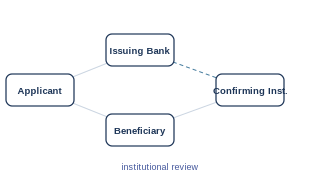
Confirmation Relationship
Institutional roles relevant to LC confirmation support: applicant, issuing bank, beneficiary and confirming institution.

Amount, currency, tenor and country

Record the face amount, currency, tenor and countries of the issuing bank and beneficiary accurately. Explain whether the request concerns a draft, issued credit or amendment, and identify the current text and any outstanding clarification. These details help an institution frame its preliminary review; they do not establish available limits or willingness to confirm. LC confirmation support should keep requested terms distinct from terms communicated by the responsible institution.

General bank-limit considerations

Institutions maintain their own country and counterparty bank limits. Availability, appetite and any conditions are established only by the institution concerned; Accord makes no representation about whether limits exist or will be made available.

Supporting documents

  • Copy or draft of the credit where available

  • Underlying contract or proforma invoice

  • Beneficiary company profile

  • Transaction summary and shipment documentation status

Trade and correspondence corridors representing cross-border LC confirmation review

Preliminary counterparty identification

Accord identifies institutions that may plausibly be relevant to the market, tenor and structure described, and coordinates preliminary contact. No institution is presented as a partner, and no response is promised.

Communication and follow-up

Accord coordinates introductions, forwards clarification requests, tracks outstanding items and keeps all parties informed until direct institutional dialogue is established. L/C confirmation support should keep a dated question log, identify who can answer each item and distinguish indicative comments from institutional decisions. Use the confirmation preparation guide and discussion checklist to organise the next exchange.

Information Architecture

Confirmation Pathway

  1. Credit Issued

    Terms settled

  2. Issuing Bank

    Country & limits

  3. Confirming Inst.

    Policy review

  4. Beneficiary

    Payment security

Institutional decision boundary

The decision to confirm, decline, or attach conditions rests entirely with the reviewing institution following its own credit, compliance and documentary review.

Common gaps

Practical LC confirmation support questions

Does a complete pack mean confirmation is available? No. A clear pack helps an institution understand the request, but it does not establish appetite, limits, pricing or an undertaking. Identify whether the bank’s actual response is a request for information, an indicative discussion or another expressly stated position, and preserve any qualifications.

Who should answer an open institutional question? Route the question to the party responsible for the underlying fact. Client commercial information and a bank’s own position have different sources. A coordinator can organise the response route without substituting its opinion for a bank’s communication or deciding whether confirmation will be provided.

Illustrative LC confirmation support scenario. For a fictional example, beneficiary details are complete but the proposed issuing-bank terms remain unconfirmed. Keep those statuses separate and ask for the relevant source clarification. The routing illustration supports this handover; it does not depict an actual bank relationship or guarantee that a response will be favourable.

LC confirmation support: route clarification to the responsible source.
Illustrative preparation aid; the relevant parties and institutions retain their own responsibilities and decisions.
  • Credit terms still unsettled when discussions begin

  • Issuing bank details incomplete or inconsistent

  • No clear presentation timeline

  • Beneficiary documentation not prepared in advance

Key takeaway
Confirmation appetite and limits are matters for the institution concerned. Clear preparation helps explain the request; it does not determine whether confirmation is available.

Keeping LC confirmation support information current

What happens when a credit or request is revised? Keep the changed record linked to the version previously supplied and identify what has actually changed. A newer file does not automatically mean an earlier review covers it. In LC confirmation support, distinguish the credit information, the applicant’s request and the institution’s response. Preserve any qualifications about the version or terms considered, and route an unresolved interpretation to the responsible institution or appropriate adviser.

For a fictional example, an updated transaction summary contains a different tenor while the supporting institutional correspondence still refers to the earlier request. Record the discrepancy and ask the authorised source to clarify the current position. Do not silently combine the documents into a supposedly agreed package. The illustration separates the document track from its review status. Record which comparison was repeated, who supplied the clarification and what remains pending. This is preparation guidance, not a statement that a particular amendment will be accepted or that confirmation remains available.

For the working detail, use L/C Confirmation Discussion Checklist.

LC confirmation support: a new document version is separate from a completed review.
Illustrative preparation aid; record the actual source, version and review status without inferring institutional approval.

Three scoping checks for LC confirmation support

The linked educational article explains the instrument and the preparation checklist supplies detailed prompts. This section addresses a different question: what coordination work is actually being requested? Define that task before treating a general request for confirmation as an instruction Accord can fulfil. The three checks below help separate the coordination enquiry from the institutional decision.

LC confirmation support may involve information spread across a beneficiary, company team and existing bank contacts. A useful request identifies the practical difficulty between those participants. It might concern an unclear requirement summary, missing source information or the organisation of a preliminary conversation. It should not assume that a named institution will participate or that an introduction establishes available limits.

Use the checks to describe the work in ordinary terms. The answers can show whether coordination would address the current difficulty or whether the question already belongs directly with a bank or an independent adviser. LC confirmation support does not replace those channels. It should help prepare an intelligible discussion while retaining the responsibilities of the people and institutions involved.

  • Which practical task remains? Identify the information or communication difficulty: an unexplained requirement, a missing source answer or a discussion that needs clearer context. Do not describe the task as obtaining a confirmation that only an institution can decide to provide.

  • Who owns the relevant instruction and information? Identify the principal making the request, the source of the credit-related records and the appropriate bank contact where one is already involved. A person assembling the pack is not automatically authorised to speak for every participant.

  • What would a useful coordination output clarify? Describe the question the next reader should be able to understand after the work. Distinguish an organised enquiry or handover from an institutional response, a quotation or an undertaking.

Define the interface with an existing beneficiary or bank discussion

If the beneficiary or its bank is already discussing the credit with an institution, explain what additional coordination is needed. A direct channel may already exist for substantive questions. The service request should identify the remaining information task rather than creating an unnecessary parallel route or presenting Accord as the party responsible for the institution’s response.

For example, a hypothetical beneficiary has a bank contact but its commercial team cannot explain which records belong to the current enquiry. The coordination question concerns organising that explanation. It is different from asking someone to interpret an institutional undertaking or negotiate terms on the bank’s behalf. LC confirmation support should preserve the distinction when the task is described.

Clarify which communications may be shared for the intended purpose and which source can explain them. A forwarded message can lose context if its sender, qualifications or relevant request are omitted. Do not replace that context with a coordinator’s assumption. The legitimate direct participants retain their own authority and responsibility for the statements they make.

LC confirmation support can help make the interface understandable within the actual engagement scope. It does not confer authority to instruct a bank, commit a beneficiary or represent that an institution has agreed to review the requirement. Where the remaining question is already answerable through a responsible direct contact, recognise that route rather than adding another layer of correspondence.

Keep separate credits and enquiries distinguishable

A company may be preparing several commercial requirements at once. Their issuing banks, beneficiaries, credit texts or discussion stages can differ. Describe each requirement distinctly before combining material in one introductory message. A general company explanation may be shared context, but it should not make separate credit-related questions appear to concern the same instrument or institutional response.

In a fictional example, one team is discussing a draft credit while another is organising information about an issued credit from a different bank. The same company profile may be relevant background to both. The LC confirmation support task is to keep each request connected to its own source records and responsible contacts. It is not to transfer a statement received about one enquiry to the other.

A short overview can identify the separate requirements and explain why they are being presented together. Then identify the principal coordination question for each. Avoid a single status label that obscures which request has received a response. The institution determines whether and how it will consider each actual requirement; the overview does not establish common treatment.

Use LC confirmation support to organise the presentation without duplicating the detailed checklist in every cover message. Refer to the appropriate current record and state the question it supports. If the relationship between the requirements is uncertain, keep that uncertainty visible for the responsible source instead of inventing a consolidated transaction narrative.

A comparison worksheet for separate credit enquiries

The following working prompts help keep separate credit enquiries distinguishable during LC confirmation support. Use one clearly labelled entry for each actual credit or proposed requirement. They are coordination prompts, not a bank application form or a substitute for the receiving institution’s requirements. An incomplete answer should remain visibly incomplete rather than being copied from another enquiry.

The worksheet is useful when a company team is preparing several requirements or when different contacts hold parts of the record. A shared company profile can be referenced without implying that every credit has the same issuing bank, beneficiary, text, institutional status or intended question. Keep the comparison focused on identifying the right source and next discussion.

For LC confirmation support, a concise comparison should help a reader select the correct underlying record. It should not compress material qualifications out of the explanation. If two entries use a similar internal label, add enough context to distinguish them without inventing an official credit reference or presenting a draft as an issued instrument.

  • Entry identity. Identify the particular credit or proposed request and the source of its reference. Where an official reference is not available, use a clearly described internal label. Do not let that label imply that the credit has been issued.

  • Record status. Identify whether the supplied text is a draft, issued credit or material relating to a proposed amendment. Name its actual source and date so the reader knows which record the discussion concerns.

  • Relevant parties. Identify the issuing bank and beneficiary described in that entry, with any unresolved identity question visible. A company-level overview must not silently transfer a bank or beneficiary from one credit entry to another.

  • Purpose of the enquiry. State why a confirmation discussion is sought for this entry and which information is presently available. Keep a company preference separate from an institution’s expressed position on the particular request.

  • Institutional communication. Connect each material response to the enquiry it actually addresses. Preserve its sender and qualifications. A reply about one credit should not appear as evidence that another credit or issuing bank has been considered.

  • Next source question. Identify the clarification needed for this entry and the responsible source. Distinguish a company record question from an institutional question rather than giving the entire comparison one unexplained “pending” label.

Worked coordination scenarios with distinct credit questions

In the first fictional scenario, a beneficiary team supplies two credit-related files with similar filenames. One is an earlier draft; the other concerns a different proposed transaction. A general request asks for confirmation support without distinguishing them. The useful coordination task is to establish which file belongs to the current enquiry and which source can explain that relationship, not to select a file because its name contains “final.”

Once the source clarifies the entries, record the distinction in the enquiry summary and refer to the appropriate current record. LC confirmation support does not determine whether either text is suitable for confirmation. The example concerns identifying the object of the discussion, before interpreting a bank’s willingness or terms.

In the second fictional scenario, a company team forwards an institutional message while its beneficiary contact describes a broader requested scope. The message addresses only the information needed for a preliminary conversation. Preserve that narrower meaning and identify the additional question the beneficiary wants answered. Do not convert the message into acceptance of the broader request.

LC confirmation support can help organise the question and its sources for the appropriate direct exchange. It cannot supply the institutional response or represent a proposed scope as agreed. Both examples illustrate preparation reasoning; neither is an actual client transaction, an institutional procedure, an approval condition or evidence of an Accord banking relationship.

Prepare the next direct exchange around the identified credit

Before the next exchange, identify the specific credit enquiry, the source record being discussed and the question the intended recipient can answer. This is particularly important if company-level information accompanies several credit entries. A recipient should not have to infer which text or issuing-bank position a follow-up message refers to.

For LC confirmation support, the handover can distinguish an information request from a request for a substantive institutional position. A company source may be able to clarify the beneficiary description or supply the relevant record. Only the responsible institution can state its own review position. Keep that difference explicit when explaining why the next message is being sent.

If the actual requirement remains unclear, resolve the relevant source question before presenting a more definite request. If the requirement is clear and direct institutional dialogue is established, identify any remaining coordination task within its actual scope rather than creating unnecessary parallel correspondence. The institution determines what information and communication it requires.

Use the linked educational article for the instrument explanation and the discussion checklist for the practical preparation prompts. LC confirmation support is not a confirmation undertaking, a quotation or a guarantee of an available limit. It helps organise an intelligible question about the identified credit while the relevant institutions and contracting parties retain their own responsibilities and decisions.

Begin with a Structured Requirement Review

Share the transaction, the parties and the documentation you already hold. Accord will organise the rest and tell you plainly what is missing.