
Skip to content
Start Requirement ReviewStart Review

Service

Structured SBLC Requirement and Documentation Coordination

SBLC facilitation support begins with a clearly identified underlying obligation. Accord organises applicant, beneficiary, proposed-bank, terms and documentation information for institutional review. Accord does not issue, fund, sell or guarantee a standby.

Underlying Obligation

Underlying Commercial Obligation

The contract the standby supports

Parties

Applicant

Beneficiary

Proposed Issuing Bank

Review

Requirement Information

Institutional Review

Accord Coordination

Preparation & coordination layer — not a party to the transaction.

  • Requirement definition
  • Documentation readiness
  • Institutional communication

Accord does not issue, sell, lease, monetize, fund or guarantee an SBLC.

Role boundary. Accord does not issue, sell, lease, monetize, fund or guarantee an SBLC. Accord does not participate in monetization programmes and does not work with instruments offered outside a genuine underlying commercial obligation.

SBLC facilitation support: underlying purpose

The underlying obligation the standby is intended to support — supply performance, payment security, contractual undertaking or facility support — is described together with the commercial agreement it derives from. SBLC facilitation support should identify the obligation, its source document and the reason the proposed beneficiary requires support. A draft must be labelled as a draft; it is not evidence that a bank accepts the wording or will issue an instrument.

On this page

Applicant information

  • Legal name, registration and ownership

  • Management profile and operating history

  • Existing banking relationships and facility position

  • Financial information the reviewing institution is likely to request

Beneficiary information

  • Legal name, jurisdiction and business activity

  • Relationship to the underlying contract

  • Beneficiary bank details where already known
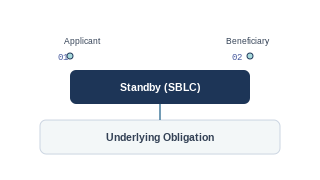
Underlying Obligation
SBLC facilitation support illustration linking the underlying obligation, standby, applicant and beneficiary.

Proposed issuing bank

Where an issuing bank has been identified, the status of discussion is documented. Where none exists, the requirement is prepared so that potentially relevant institutions may be approached for preliminary review only.

Proposed terms

  • Amount and currency

  • Validity period and expiry arrangements

  • Governing rules referenced by the parties

  • Drawing conditions contemplated by the underlying contract

Underlying documents

Index the current contract and relevant requirement, proposed wording, dates and the people responsible for clarification. The ICC introduction to standby practices explains the distinct standby context. Applicable text, rules and legal questions require the relevant institution and appropriate advice.

  • Sales, supply or service contract

  • Proforma invoice or purchase order

  • Corporate documents and company profile

  • Project or transaction summary where applicable

Abstract institutional stone columns representing structured SBLC review

Compliance and due-diligence readiness

Institutions apply know-your-customer, sanctions and source-of-funds review. Parties should expect to provide ownership information, identification documents and transaction background directly to the institution.

Information commonly requested

  • Purpose and beneficiary of the standby

  • Underlying commercial obligation and its value

  • Applicant financial standing

  • Security or cash cover the applicant can discuss with its bank

Information Architecture

Readiness Sequence

  1. Underlying obligation documented

    The contract the standby supports

  2. Applicant & beneficiary information

    Profiles, ownership, relationship

  3. Proposed terms defined

    Amount, currency, validity, drawing conditions

  4. Institutional review prepared

    Decision remains with the institution

Institutional communication

Accord coordinates introductions, information exchange, clarification and follow-up, and prepares the parties for direct institutional review. The SBLC facilitation support pack should separate confirmed facts, pending information and proposed bank roles. The SBLC readiness guide and requirement checklist help organise preparation without promising approval.

Warning signs and incomplete submissions

Practical SBLC facilitation support questions

Can an earlier standby draft be reused unchanged? A prior draft does not establish that its terms fit a different underlying obligation. Identify the current source documents, parties, purpose and open wording questions. Keep a proposed text marked draft while the responsible parties and institutions determine the actual terms applicable to the requirement.

What does exchanging a draft establish? It establishes only what the correspondence actually says. Do not infer approval, issuance, a bank undertaking or agreed charges from a template being exchanged. Keep the draft version and institutional response linked, and make unresolved questions visible to the party authorised to answer them.

Illustrative SBLC facilitation support scenario. In a fictional example, the beneficiary requests text before the applicant can explain the obligation it should support. Record the missing source and clarify that question before presenting the wording as settled. The illustration separates obligation, draft and institution response; it is a preparation aid, not an issuance sequence.
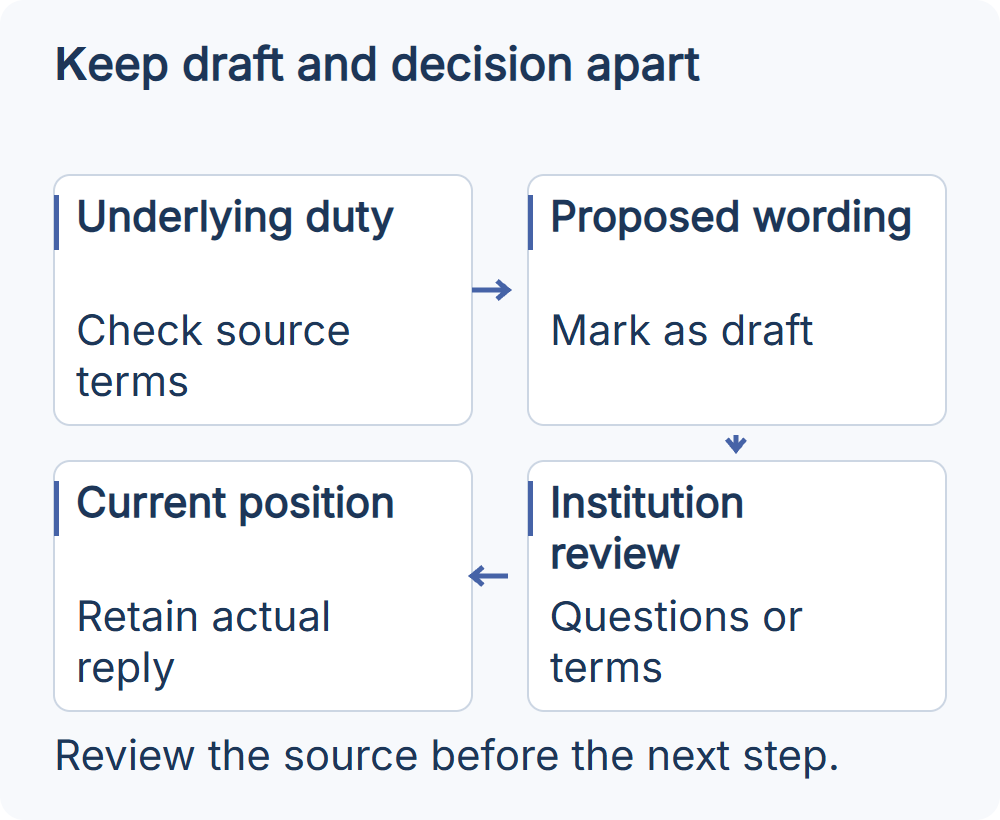
SBLC facilitation support: keep obligation, proposed wording and institution response distinct.
Illustrative preparation aid; the relevant parties and institutions retain their own responsibilities and decisions.
  • Requests referring to leased instruments, monetization or guaranteed proceeds

  • No identifiable underlying commercial transaction

  • Refusal to provide ownership or identification information

  • Unrealistic timelines or pressure to bypass institutional review

Key takeaway
Describe the underlying obligation and identify its source. If supporting records are incomplete, make that limitation and the next clarification visible.

Keeping SBLC facilitation support information current

How should a changed obligation or draft be handled? Identify the changed source and the question it creates for the proposed standby wording. A revision to a commercial record should not be treated as an automatically approved change to an institutional undertaking. Keep the underlying obligation, proposed text and institution response distinguishable. In SBLC facilitation support, the coordinator can organise the comparison and communication without deciding the legal effect or institutional acceptability of a change.

For example, a beneficiary description may differ between two versions supplied for discussion. Flag the difference, identify the current source and refer the wording question to the responsible parties. Do not resolve it by copying the more convenient wording into every record. The version-and-review illustration shows why a new file and a completed assessment are separate statuses. Retain the response and its qualifications, and make any unresolved issue visible before another circulation. No universal wording, approval sequence or issuance outcome is prescribed by this preparation method.

For the working detail, use SBLC Requirement Checklist.

SBLC facilitation support: a new document version is separate from a completed review.
Illustrative preparation aid; record the actual source, version and review status without inferring institutional approval.

Three scoping checks for SBLC facilitation support

The existing article explains standby preparation and the checklist provides working prompts. Before using those resources, identify the coordination task being requested. A request framed only as “we need an SBLC” does not explain the obligation, the relevant instruction or the work Accord is being asked to organise. The three checks below help make that distinction without choosing the instrument’s terms.

SBLC facilitation support can help organise source information and institutional communication within its actual scope. It does not supply an instrument, certify a draft or decide whether proposed wording is legally effective. The initial task should be described in terms of a preparation question that the responsible participants can address.

If one of these checks exposes a material uncertainty, state it in the enquiry rather than filling the gap with a familiar template. SBLC facilitation support should help the reader understand what needs clarification. A polished draft cannot establish an underlying commercial explanation or another party’s authority.

  • Obligation source. Identify the commercial obligation the proposed standby is intended to support and the record that describes it. If that explanation is unsettled, name the source who can clarify it instead of choosing wording that assumes the answer.

  • Instruction and parties. Identify who is requesting the proposed support, who is described as applicant and beneficiary, and the capacity in which a contact is speaking. Do not infer authority or an entity relationship merely from a forwarded message or a shared brand.

  • Actual institutional position. Identify what the proposed bank has actually communicated about the current requirement, if anything. Separate an institution named in a proposal from one that has stated its own position. The institution decides whether it will consider or issue any instrument.

When a proposed standby precedes a clear commercial explanation

A company may request a draft before the underlying commercial explanation has been settled. The useful coordination question is what information is needed to understand the proposed obligation. Identify the relevant contract or other source, the parties named and the point the applicant or beneficiary wants to clarify. Do not use a draft to supply facts that the commercial parties have not established.

For a fictional example, a beneficiary asks for wording while the company contact supplies only a general project description. The next task in SBLC facilitation support is to identify the particular obligation that the proposed standby is intended to address. A project name alone may not explain which party owes what to whom. The responsible source must clarify the actual requirement.

Once that explanation is available, distinguish the commercial facts from any question about the proposed text. Coordination can make the questions legible without deciding the legal effect of the text. Where interpretation or drafting advice is needed, recognise the role of the appropriate institution and independent adviser rather than presenting a coordinator’s revision as an authoritative solution.

SBLC facilitation support is therefore an information task within an actual scope, not a shortcut from an incomplete narrative to an agreed instrument. The relevant institution determines its own information requirements and terms. Keep the preparation limitation visible instead of treating a document headed “standby” as a complete account of the obligation.

Clarify mismatched instructions before circulating another text

A commercial instruction and a wording request can come from different sources. The first may describe the underlying obligation while the second expresses a beneficiary’s proposed requirement. If they appear to concern different parties or purposes, identify that mismatch before combining them into a single supposedly settled request. A coordinator should not decide which source overrides the other.

In a hypothetical enquiry, an applicant contact describes one obligation while a forwarded beneficiary message appears to request support for a different one. SBLC facilitation support can organise a clear question identifying the two descriptions and the sources responsible for them. It cannot resolve the commercial disagreement by selecting the wording that is easiest to reproduce.

Keep the enquiry specific. Identify which part of the explanation needs clarification and why it affects the proposed requirement. Avoid sending a long chain of correspondence with no account of the unresolved question. The appropriate principals may need to communicate directly, and an interpretation of contractual effect may require independent advice.

After clarification, preserve the source and its limits when the request is restated. SBLC facilitation support does not certify that the clarification is accurate or that an institution accepts the resulting text. The purpose is to avoid concealing an unresolved source question behind a more polished presentation.

Separate multiple obligations in a coordination brief

A business may mention several contracts, project activities or related entities in one enquiry. Identify whether the proposed standby question concerns one obligation or several distinct obligations. Do not assume that an instrument discussed for one purpose applies to another. The relevant institutions and parties determine the actual structure and legal terms.

A short comparison can help organise SBLC facilitation support without interpreting coverage. Give each source obligation a clear label and identify the parties described in that record. Then state the proposed standby question associated with it. Where the relationship between obligations is uncertain, refer that question to the responsible commercial source or appropriate adviser.

For a fictional illustration, one company contact refers to a supply agreement while another refers to a project-performance obligation. Similar company names do not establish that these are the same requirement. The coordination task is to make the distinction visible and identify who can explain the intended request, not to decide that one proposed instrument covers both.

SBLC facilitation support should preserve the differences that matter to the explanation. A consolidated cover note can provide context, but it should not erase separate parties, sources or unanswered questions. Use the comparison prompts below as a working aid; they are not a bank application or a representation that any combined arrangement is available.

  • Commercial record. Identify the source document and the specific obligation it is said to describe; keep an unclear obligation marked for clarification.

  • Parties and capacity. Identify the entities described in that record and the source of any stated relationship between them; do not invent authority from a group name.

  • Proposed standby question. State which requirement is being discussed for this obligation and what remains to be clarified by the responsible parties or institution.

  • Cross-reference limitation. Explain why another obligation appears in the same brief. Background context is different from a statement that the same proposed instrument applies to both.

Recognise requests that fall outside the facilitation scope

A request to organise information is different from a request to provide, fund, sell or guarantee a standby. Accord does not occupy those institutional roles. If an enquiry assumes that the coordinator supplies an instrument or determines a bank’s willingness to issue, clarify that misunderstanding before treating it as an ordinary documentation task.

SBLC facilitation support also should not be described as authentication of a purported bank undertaking or confirmation that a third-party document has legal effect. Those questions belong with the appropriate responsible institution and professional advice. Clear source attribution can help organise a query, but it does not turn the coordination service into an instrument-verification service.

Consider a fictional message offering a supposed instrument while asking the recipient to infer its value or availability from an attached copy. The coordination task cannot establish authenticity or an institutional commitment from that attachment. Identify the actual source question and the appropriate independent channel rather than treating an attractive presentation as evidence of a bank’s position.

The relevant point for SBLC facilitation support is scope, not a promise that every unclear request can be repaired into an acceptable transaction. A principal may need an institutional answer, legal advice or a clearer commercial agreement before any useful coordination task can be defined. Keep that dependency explicit and avoid implying that a preparation service replaces it.

Prepare the next question about the identified obligation

A useful next communication identifies the obligation under discussion, the source record and the question the intended recipient can answer. If an enquiry includes several obligations, make clear which one the message concerns. The recipient should not have to infer the relevant commercial source from a collection of draft texts and unrelated correspondence.

For SBLC facilitation support, distinguish a company clarification from an institutional question. A principal may explain the intended commercial purpose, while an institution determines its own view of the proposed requirement. A coordinator can organise the exchange without supplying either party’s answer. Where a response depends on legal interpretation, recognise the need for the appropriate advice.

The practical output should preserve what remains unresolved. A clarified obligation description is not evidence of issuance; a proposed text is not a bank undertaking; a communication being routed is not a favourable decision. Keeping these statements distinct helps the next reader understand the request without creating an implied commitment.

Use the SBLC requirement checklist for the working preparation record and the linked article for the educational explanation. SBLC facilitation support remains coordination within its actual scope. The institution and contracting parties retain responsibility for their own terms, reviews and decisions, and Accord does not promise that the proposed standby or any related financial outcome will be available.

Begin with a Structured Requirement Review

Share the transaction, the parties and the documentation you already hold. Accord will organise the rest and tell you plainly what is missing.