
Skip to content
Start Requirement ReviewStart Review

Readiness Resource

Foreign Counterparty Development Checklist

What to define and prepare before approaching potential counterparties in another market.

Market Mapping
0102030405MarketMapping

Using the foreign counterparty development checklist

Use this foreign counterparty development checklist to define the product, intended relationship, proposed scale, timing and candidate criteria before outreach. Record sources and dates, identify uncertainty and obtain the client's approval of the shortlist and introduction. Prepare consistent information and a response owner rather than treating a directory entry as a verified partner. The development process guide explains the sequence. U.S. trade guidance offers a context-specific evaluation reference, not a Bangladesh rule. Principals decide commercial terms and perform appropriate checks; introductions do not guarantee outcomes.

On this page

Intended user

Companies seeking suppliers, buyers or commercial partners abroad.

Choose comparison criteria before treating a candidate as a match. Keep the requirement, source quality, unknowns and authority to share separate from a later response or agreement.
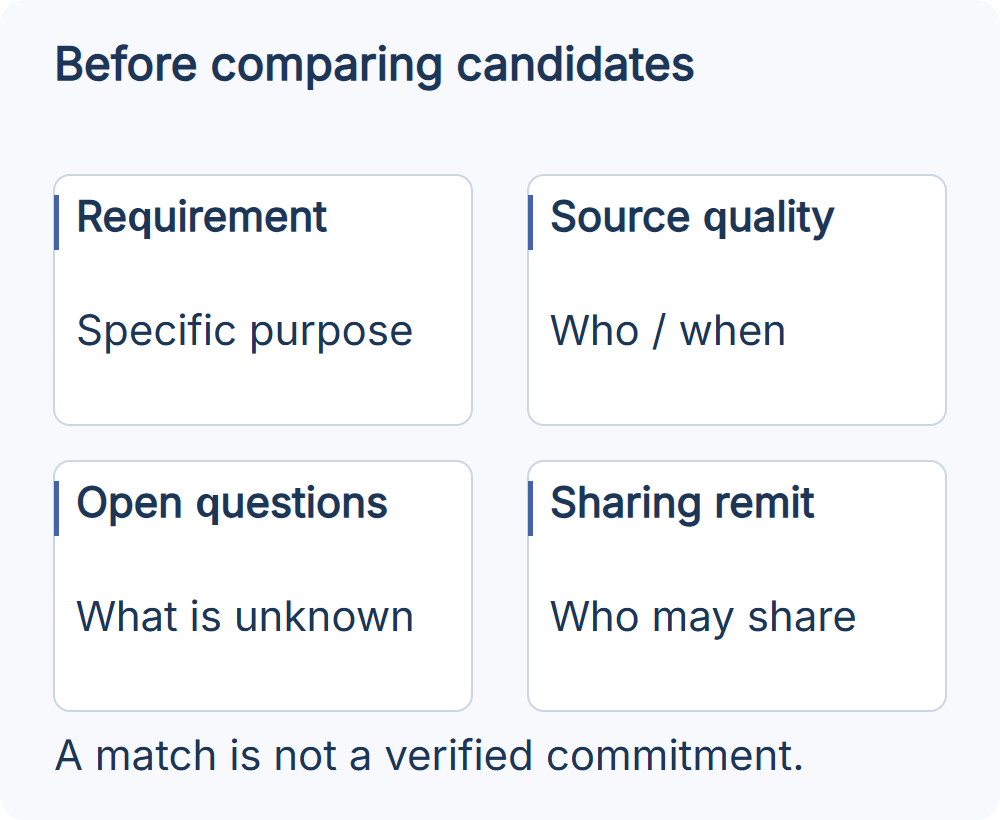
Foreign counterparty development checklist: compare requirement, source quality, unknowns and sharing authority.
Foreign counterparty development checklist: preserve the actual source, sharing authority and qualifications.

Information and documents

Foreign counterparty development checklist: working record. Record why each candidate appears relevant, the source of that information and what remains unknown. A public listing or website can justify further research without establishing present capacity, willingness or trustworthiness. Before outreach, obtain the principal’s authority for the recipient, purpose and material to be shared. Check for an existing approach through another channel so that the candidate does not receive contradictory introductions.

When a candidate source or response qualification changes, record its source and version separately from the review outcome. A received file can be current while the question it raises remains open; the illustration separates those two checks.

  • Requirement definition: product, volume, terms
  • Target counterparty profile
  • Markets and jurisdictions in scope
  • Introduction pack and company profile
  • Payment or instrument expectation
  • Approved contact list
  • Response log and follow-up owner
  • Due-diligence approach for shortlisted parties
Foreign counterparty development checklist: document versions and review outcomes are separate checks.
Foreign counterparty development checklist: a new version is not a completed institutional review.

Common gaps

Route a candidate’s qualified response without treating permission for one conversation as authority for wider outreach. The circulation loop separates source clarification, permission to share and the next qualified handover.

  • Requirement too broad to act on
  • No documentation ready when interest arises
  • Inconsistent messaging
  • No follow-up owner
Foreign counterparty development checklist: clarify the source, permission to share and qualified handover.
Foreign counterparty development checklist: preserve the actual source, sharing authority and qualifications.

Practical notes

Ask the principal to define the required product or service, market, commercial criteria and approved scope of outreach. Record where candidate information came from and when it was checked; distinguish a researched lead from an evaluated or contracted counterparty. Agree who may make contact and what may be disclosed. Log unanswered questions without implying that an introduction establishes suitability. The principals and their advisers carry out their own due diligence and negotiate contracts, pricing and protections. Accord's preparation and coordination do not constitute a guarantee of a counterparty or commercial outcome.

Use the response illustration when updating the working checklist. A request for clarification is an information question; silence is an unresolved response; neither establishes a commercial commitment. For a fictional candidate, the next action might be to obtain a specification from the authorised technical contact rather than send a larger generic presentation. Keep that action, its owner and the evidence needed visible. If an unexpected payment or sensitive-document request arrives, pause and refer it through the principal’s appropriate verification process rather than treating shortlist inclusion as approval. The checklist supports research and communication, not certification, guaranteed counterparties or authority to agree commercial terms.

Foreign counterparty development checklist: distinguish an untested candidate from an authorised approach and actual response.
Illustrative preparation aid. Use it with the working notes; the receiving institution determines its actual requirements.

Role reminder

Accord coordinates preparation, documentation readiness and institutional communication. Accord is not a bank, lender, issuer, confirmer, guarantor, funder or credit decision-maker. All facilities, pricing, security, due diligence, compliance, approval, issuance, confirmation and decisions remain with the relevant institutions and contracting parties.

Working instructions for the foreign counterparty development checklist

Keep the original list above as the main working tool. Each entry should identify the requirement being addressed, the source supporting the current description and the person able to clarify a material gap. A completed preparation record is not a verified supplier, buyer or partner and should not be presented as one.

The foreign counterparty development checklist should distinguish four statuses: a candidate identified for further enquiry, an authorised approach, a response received and a commercial decision by the principal. These describe different activities. Do not let a single “approved” label imply that every stage has been completed or that Accord has certified the candidate.

Start with the principal’s actual requirement and keep the candidate information tied to it. A company may be active in a relevant market without offering the required product or wishing to discuss the proposed scale. Public information can justify a question while leaving the answer unknown.

For the foreign counterparty development checklist, a useful preparation tick records what has been done within its stated scope. Identify uncertainty explicitly and preserve the principal’s control of outreach and commercial decisions. The working resource does not replace appropriate due diligence, specialist advice or the parties’ own contractual assessment.

Make product and volume criteria usable for comparison

Identify the product or service requirement and the source able to clarify its material features. Distinguish an essential specification from a preference that the principal is willing to discuss. A broad category may produce many names without identifying which candidates could answer the actual commercial question.

Use the foreign counterparty development checklist to record the proposed scale and its status. A planning estimate, a one-off enquiry and an agreed purchase volume are different descriptions. Do not present a tentative figure as an order or suggest that a candidate has accepted it before an actual response supports that statement.

In a fictional sourcing exercise, the principal wants a defined technical feature while the initial list includes companies advertising only a general category. The useful next action is a source-based question about the feature, not a claim that every listed business is a suitable supplier. Identify the authorised technical contact for follow-up.

The foreign counterparty development checklist should show why a criterion matters to the current enquiry. Do not add unrelated requirements merely to make a comparison appear rigorous. The principal and its appropriate advisers determine technical and commercial suitability; Accord organises research and communication without certifying a product or candidate.

Record what the candidate source actually establishes

Identify where each candidate detail came from and when it was reviewed. A public website, directory listing, referral and direct response offer different kinds of information. A source may support a general description while leaving current capability, entity identity or willingness to engage unanswered.

For the foreign counterparty development checklist, separate a source claim from a conclusion independently established by the principal. If a business describes its own activity, attribute that description. Do not remove the attribution and present the same statement as an Accord verification merely because it has been copied into a shortlist.

In a hypothetical candidate record, an older directory entry names a product that is absent from the current company website. Record the difference and the question requiring clarification. Choosing the older statement because it fits the requirement would conceal uncertainty instead of improving the evidence.

Use the foreign counterparty development checklist to identify what additional source or direct question would be useful. A candidate may remain appropriate for further enquiry without being described as proven or trustworthy. The principal determines its own verification and due-diligence process, and the coordinator should preserve the limits of the information collected.

Explain market scope without implying unrestricted suitability

Identify the markets and jurisdictions the principal wishes to consider and the commercial reason for that scope. A company’s public address or stated international activity does not establish its ability to supply, purchase or contract on the proposed basis. Keep those questions separate from the fact that the candidate was found in a relevant search.

The foreign counterparty development checklist should distinguish the principal’s preference from a verified candidate position. If delivery, local support or another market-specific issue matters, identify the source able to answer it. Avoid assuming that a candidate’s general marketing statement covers the actual location, product and proposed commercial arrangement.

In a fictional enquiry, a business advertises international sales while the principal needs a specific support arrangement in the intended market. The next useful question concerns that arrangement. A larger company profile would not by itself establish that the need can be met or that a proposed transaction is permitted.

Where legal, regulatory or other specialist restrictions may be relevant, route the actual question through the principal’s appropriate advisers and checks. The foreign counterparty development checklist does not provide clearance or prescribe a universal compliance programme. Accord can organise the information without certifying cross-border eligibility or removing the principal’s responsibilities.

Keep a shortlist rationale instead of a guarantee label

For each candidate, state why it appears worth further enquiry and identify the information still unknown. Use the same relevant criteria when comparing candidates, but preserve differences in source quality and response status. A neat table should not make incomplete records appear equally well established.

Use the foreign counterparty development checklist to distinguish “matches a public description” from “answered the principal’s specific question”. A candidate that has responded may still need further assessment. A candidate that has not responded should not be treated as unwilling or unsuitable without a basis for that conclusion.

In a hypothetical comparison, one company lists the relevant product publicly while another has supplied a qualified direct explanation. The record can show those different bases without declaring either a verified partner. The principal can then decide which clarification or specialist review is useful before continuing.

The foreign counterparty development checklist should also record why a candidate is paused or removed from the current enquiry. A changed requirement or missing response is different from a verified adverse finding. Use factual language and avoid unsupported reputational statements, implied endorsements or claims that shortlist inclusion assures a commercial outcome.

Confirm the authorised introduction and prevent conflicting approaches

Before outreach, identify the intended recipient, purpose and material the principal has authorised for that approach. A company profile prepared for one audience may contain information unsuitable for wider circulation. Permission to identify candidates does not automatically authorise every contact or every disclosure.

For the foreign counterparty development checklist, check whether another principal contact or adviser is already approaching the same candidate about the requirement. Conflicting messages about product, scale or timing can make a useful response harder to obtain. Clarify the agreed communication route without implying that a coordinator has authority to negotiate or bind the principal.

In a fictional exercise, one contact proposes a trial quantity while another sends an annual-volume presentation to the same candidate. The next action is to clarify the intended message with the authorised principal source. Sending further introductions before resolving the mismatch would increase ambiguity rather than improve market coverage.

Use the foreign counterparty development checklist to record what was approved, who sent it and who owns the follow-up. Keep the candidate’s response within its actual scope. Accord coordinates approved communication; the principal retains its commercial instructions, specialist assessment and decision whether to pursue a relationship.

Classify responses and route specialist questions to the right owner

A response log should identify what the candidate actually said and the question it addresses. A request for a specification, a willingness to discuss and a commercial proposal are different replies. Preserve qualifications and do not turn a courteous acknowledgement into an indication of capacity or agreement.

The foreign counterparty development checklist should identify the next response owner. A technical question may need the principal’s specialist contact; a contractual issue may need appropriate professional advice. The coordinator can organise the route without supplying unsupported answers or treating a commercial contact as the authority for every subject.

In a hypothetical follow-up, a candidate asks about the intended use of a product. The useful action is to obtain an authorised technical explanation, not to send an invented specification or a larger generic brochure. Record which question remains open after the answer so the next communication stays focused.

An unexpected payment instruction or request for sensitive material requires the principal’s appropriate verification process. The foreign counterparty development checklist should not treat a familiar contact or shortlist status as proof of legitimacy. Accord does not authenticate counterparties, guarantee payment safety or replace the principal’s independent checks and professional judgement.

Resolve the four common gaps before the next approved step

The four common gaps above concern an overly broad requirement, unavailable documentation, inconsistent messaging and an absent follow-up owner. Identify the exact deficiency in the working record. Adding more names will not resolve an undefined specification, and a complete company brochure will not answer a missing technical or institutional question.

Use the foreign counterparty development checklist with the development service page for Accord’s coordination scope and the process article for the wider educational explanation. Keep this resource focused on working entries and clarification tasks rather than reproducing a whole research methodology or another promotional introduction.

A compact record can use these fields: requirement criterion; candidate source and review date; unanswered question; authorised recipient; response owner; next action. Keep the actual reply beside the question it addresses. If the reply supplies a catalogue but does not answer the specification question, record the attachment as received while leaving that question open for clarification.

A fictional record might read: “Candidate identified from the stated public source; product detail not yet confirmed; principal approved a limited enquiry; technical contact assigned to answer the expected question.” This makes the next step intelligible without suggesting a verified partner, a bank relationship or a commercial commitment.

Before continuing, confirm the current requirement, authorised recipients and response owners. The foreign counterparty development checklist supports orderly preparation while material unknowns remain visible. Commercial principals and relevant institutions retain their own due diligence, negotiations, contractual responsibilities and decisions; Accord’s coordination does not guarantee a suitable counterparty or successful transaction.

Begin with a Structured Requirement Review

Share the transaction, the parties and the documentation you already hold. Accord will organise the rest and tell you plainly what is missing.